
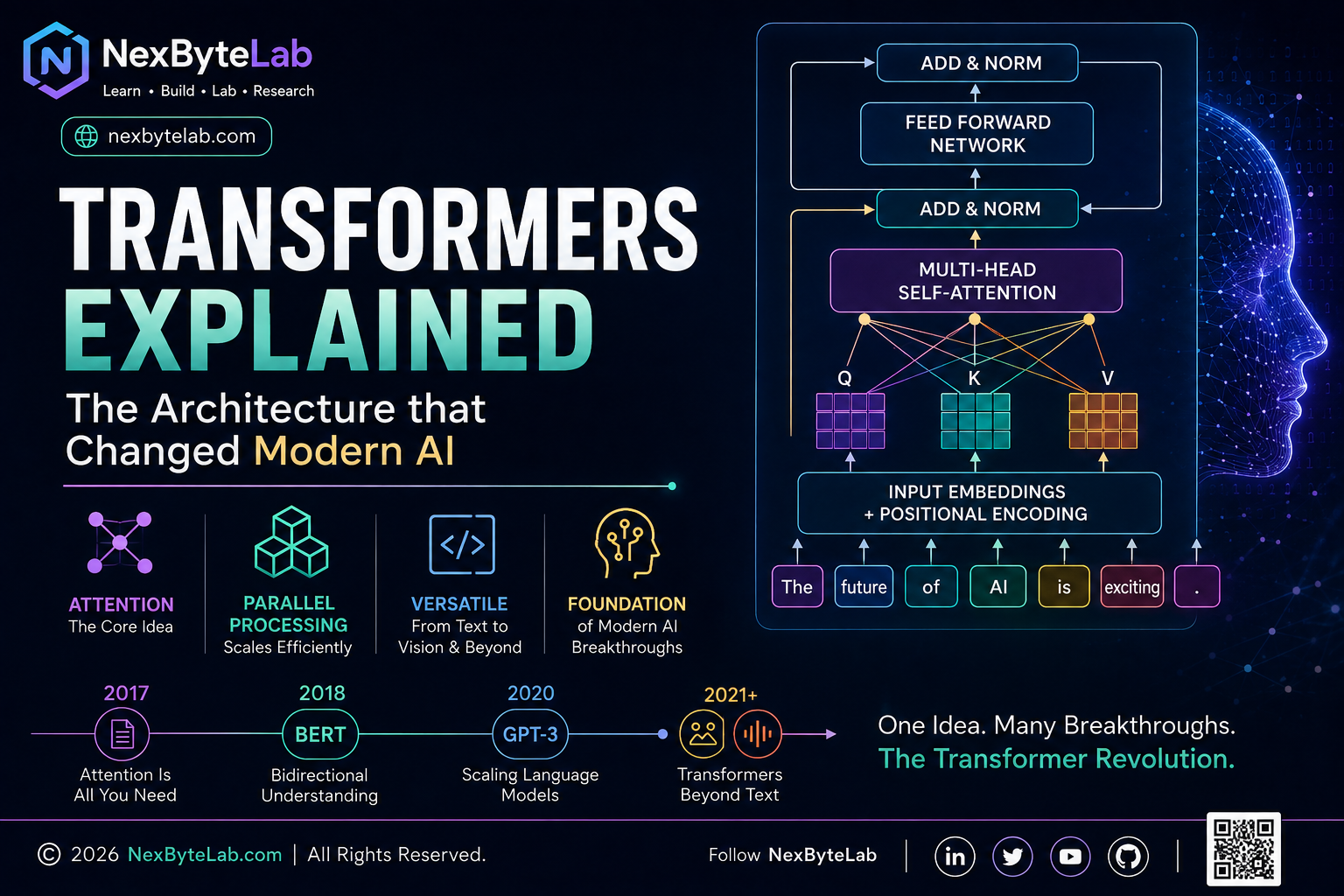
Transformers Explained: The Architecture that changed Modern AI
Transformers are the architecture that changed modern AI: a single mechanism, self-attention, that let models trade recurrence for parallel computation at scale.
Consider this transformer architecture explained from the ground up: the design decisions that let today’s AI systems understand context at scale.
If you have used ChatGPT, an AI search engine, a translation tool, or one of today’s advanced language models, you have probably interacted with technology built around a Transformer.
The Transformer did not begin as an attempt to build a chatbot. It emerged from research into a much more specific problem: how can computers process sequences such as language more effectively?
In 2017, Ashish Vaswani and colleagues introduced the Transformer architecture in their landmark paper, Attention Is All You Need [1]. Their central idea was surprisingly powerful: instead of processing a sentence strictly one word after another, a neural network could use attention to determine which parts of the input were most relevant to one another.
That change helped reshape modern artificial intelligence.
This article explains what a Transformer does, why attention matters, and why the architecture became so influential — without requiring advanced mathematics.
Before Transformers: Why Sequences Were Difficult
Consider the sentence:
The farmer who inspected the damaged crops yesterday said they needed treatment.
To understand what “they” refers to, a model needs information appearing earlier in the sentence.
Earlier sequence models, particularly Recurrent Neural Networks (RNNs), process information sequentially. Conceptually, they read one element, update an internal representation, move to the next element, and repeat.
This approach can work well, but long sequences create challenges. Information must travel through many computational steps, and the sequential nature of recurrence also limits how much of the computation can be performed simultaneously.
The researchers behind the Transformer proposed a different approach.
Instead of relying on recurrence, their architecture was built primarily around attention mechanisms [1].
The Central Idea: Attention
Imagine reading this sentence:
The animal didn’t cross the street because it was tired.
When you encounter the word “it,” you naturally look at the surrounding context and infer that it probably refers to “the animal.”
You do not treat every earlier word as equally important.
A Transformer attempts something conceptually similar.
For each token, the model calculates how strongly it should relate to other tokens in the sequence. This mechanism is called self-attention.
Rather than asking only:
“What came immediately before this word?”
the model can effectively ask:
“Which parts of this sequence are most useful for representing this word in its current context?”
This ability to model relationships between different positions is one of the fundamental ideas behind Transformers [1].
How Self-Attention Works
The mathematics behind attention can become sophisticated, but its basic structure is approachable.
For every token, the Transformer produces three learned representations known as:
- Query (Q)
- Key (K)
- Value (V)
A useful analogy is a search system.
The Query represents what a token is looking for.
The Key represents what another token offers or describes.
The Value contains the information that may be retrieved.
The model compares queries with keys to calculate attention scores. Those scores determine how strongly the corresponding values influence the resulting representation.
The original Transformer expresses its scaled dot-product attention operation as [1]:
Attention(Q, K, V) = softmax(QKᵀ / √dₖ)V
You do not need to memorize the equation to understand the idea.
In plain English:
compare → score → normalize → combine information
The model learns which pieces of information deserve more attention for the task it is performing.
Why Is It Called “Self”-Attention?
Attention mechanisms existed before the Transformer.
The important distinction is that self-attention allows elements within the same sequence to attend to one another.
Take:
The bank approved my loan.
and:
We sat on the bank of the river.
The word bank is identical in both sentences, but its meaning changes because of the surrounding words.
Through self-attention and subsequent neural-network layers, a Transformer can construct context-dependent representations of tokens rather than treating a word as having exactly the same representation everywhere.
That contextual modelling became particularly important in systems such as BERT, which was designed to learn deep bidirectional representations by conditioning on both left and right context [2].
Multi-Head Attention: Looking at Several Relationships
Transformers do not normally perform just one attention calculation.
They use multi-head attention.
Instead of learning only one pattern of relationships, multiple attention heads operate using different learned projections [1].
One head might become useful for certain syntactic relationships. Another may capture different positional or semantic relationships. Importantly, we should not assume that every attention head corresponds neatly to a human-interpretable linguistic concept.
The broader idea is simpler:
multiple heads give the model multiple representational spaces in which to examine relationships among tokens.
Their outputs are then combined and processed by later layers.
But Computers Do Not Understand Words
Before attention can operate, text must first be represented numerically.
Modern language systems generally break text into units called tokens. Depending on the tokenizer, a token may represent a word, part of a word, punctuation, or another text unit.
Each token is mapped to a vector — a collection of numbers called an embedding.
You can think of an embedding as a location in a high-dimensional mathematical space.
These numerical representations give the network something it can compute with.
But this creates another problem.
How Does a Transformer Know Word Order?
Self-attention by itself does not inherently encode the order of a sequence.
Consider:
Dog bites man.
and
Man bites dog.
The same words appear in both sentences, but their order changes the meaning dramatically.
The original Transformer addressed this using positional encodings, which were added to the input embeddings so that information about token position entered the model [1].
The 2017 paper used sinusoidal functions for these encodings, although later Transformer architectures developed other ways of representing position.
So the model effectively receives information about both:
what the token is
and
where it occurs in the sequence.
A Transformer Is More Than Attention
It is tempting to describe a Transformer as simply “an attention model,” but the actual architecture contains several important components.
A Transformer block typically combines mechanisms such as:
multi-head attention → feed-forward neural network → residual connections → normalization
The original 2017 architecture used an encoder-decoder structure designed for sequence-to-sequence tasks such as machine translation [1].
That distinction matters because later Transformer models did not all use exactly the same architecture.
For example:
BERT — primarily encoder-based
Google researchers introduced BERT (Bidirectional Encoder Representations from Transformers) in 2018. BERT was designed to learn representations using context from both directions and could subsequently be fine-tuned for tasks including question answering and language inference [2].
GPT — decoder-style autoregressive modelling
The GPT family follows an autoregressive approach: given previous tokens, the model predicts subsequent tokens.
Research on GPT-3 demonstrated that scaling this approach to 175 billion parameters produced strong few-shot performance across numerous language tasks without task-specific gradient updates during evaluation [3].
This distinction gives us a useful mental model:
Encoder-oriented Transformers are especially useful for understanding representations, while autoregressive decoder-style Transformers are naturally suited to generating sequences.
That is a simplification, but it is a useful starting point.
Why Transformers Were Such an Important Breakthrough
One of the Transformer paper’s major engineering advantages was parallelism.
RNNs inherently perform recurrent computations across sequence positions. The Transformer removed recurrence from its core architecture, allowing substantially more computation across positions to occur in parallel during training [1].
This matters enormously on modern accelerators such as GPUs.
But parallel computation is only part of the story.
Self-attention also creates comparatively short computational paths between different positions in a sequence. Information from one token can directly influence the representation of another through an attention layer rather than necessarily travelling through every intermediate recurrent step.
The combination of:
attention + parallel computation + large datasets + increasingly powerful hardware
helped make Transformers highly scalable.
Research such as GPT-3 later showed that increasing model scale could substantially improve few-shot capabilities across many tasks, although larger models also introduced limitations, costs, and broader societal concerns [3].
Transformers Moved Beyond Language
Another remarkable development was that Transformers turned out not to be limited to text.
Researchers began representing other forms of information as sequences.
One influential example is the Vision Transformer (ViT).
Instead of treating an image exclusively through conventional convolutional operations, Dosovitskiy and colleagues divided images into patches and processed sequences of those patches using a Transformer. When pretrained on sufficiently large datasets, ViT achieved strong image-classification performance compared with established convolutional approaches [4].
This demonstrated something important:
The Transformer is not fundamentally a language architecture. It is a general architecture for modelling relationships within structured sequences of information.
Transformer-based ideas have subsequently influenced research across multiple AI domains.
Does Attention Solve Everything?
No.
The original form of self-attention has an important computational limitation.
If a sequence contains n tokens, standard self-attention compares relationships across token positions, producing an attention matrix whose size grows roughly with n².
In practical terms, doubling the sequence length can make the attention computation considerably more expensive.
This scaling challenge has motivated extensive research into more efficient attention mechanisms and architectures capable of handling longer contexts.
So Transformers are powerful, but they are not computationally free.
A Simple Mental Model
If you remember only one idea from this article, use this one.
Imagine a meeting with ten people.
An older sequential system resembles information being passed from:
Person 1 → Person 2 → Person 3 → … → Person 10
A self-attention mechanism is closer to allowing each participant to determine:
“Whose information is most relevant to what I need right now?”
Different participants can draw information from different people.
That does not reproduce the mathematics exactly, but it captures an important intuition behind self-attention.
Why This Matters for Modern AI
The 2017 Transformer paper was originally demonstrated on machine translation [1].
Its influence became much broader.
BERT showed how Transformer encoders could produce powerful bidirectional language representations [2]. GPT-style models demonstrated the strength of autoregressive Transformer language modelling at increasing scale [3]. Vision Transformer research showed that the architecture could also be successfully applied to image patches [4].
The important lesson is therefore larger than any individual model.
The Transformer provided AI researchers with a flexible computational framework for learning relationships across sequences — one that could be trained efficiently on modern hardware and adapted to very large datasets and models.
That is one of the major reasons it became a foundation of modern AI research.
From Research Paper to Today’s AI
The progression can be simplified as:
2017 — Transformer architecture
Attention Is All You Need
↓
2018–2019 — Large-scale Transformer language representation
Models such as BERT demonstrate powerful pretrained representations.
↓
2020 onward — Scaling and broader capabilities
Large autoregressive Transformer models demonstrate increasingly capable few-shot language behaviour.
↓
Transformers beyond text
Architectures such as Vision Transformer demonstrate that similar principles can be applied to other data modalities.
The field has evolved considerably since 2017, but attention-based Transformer architectures remain central to modern AI.
The Key Takeaway
Transformers changed AI not because computers suddenly began “thinking like humans,” but because researchers found a highly effective way for neural networks to model relationships between different parts of their input while enabling substantial parallel computation during training.
That distinction is important.
A Transformer is ultimately a mathematical model trained to learn statistical patterns from data.
Yet the combination of token representations, positional information, attention, neural-network layers, data, computation and scale has produced systems capable of remarkably sophisticated behaviour.
And it all traces back to a deceptively simple research question:
What if a sequence model did not need recurrence at all?
The resulting paper was appropriately titled:
“Attention Is All You Need.”
References
[1] Vaswani, A., Shazeer, N., Parmar, N., et al. (2017). Attention Is All You Need. Advances in Neural Information Processing Systems (NeurIPS 2017).
Original paper on arXiv
[2] Devlin, J., Chang, M.-W., Lee, K., & Toutanova, K. (2019). BERT: Pre-training of Deep Bidirectional Transformers for Language Understanding. Proceedings of NAACL-HLT 2019, pp. 4171–4186. DOI: 10.18653/v1/N19-1423.
BERT paper — ACL Anthology
[3] Brown, T. B., Mann, B., Ryder, N., et al. (2020). Language Models are Few-Shot Learners. Advances in Neural Information Processing Systems 33.
GPT-3 research paper and overview
[4] Dosovitskiy, A., Beyer, L., Kolesnikov, A., et al. (2020/2021). An Image Is Worth 16×16 Words: Transformers for Image Recognition at Scale. International Conference on Learning Representations (ICLR 2021).
Vision Transformer paper on arXiv
Next in this series
In the next article, we can move from theory to experiment:
Building a Minimal Transformer From Scratch in PyTorch — and Comparing It With an RNN
Rather than simply showing code, we can treat it as a small reproducible experiment: train both models on the same dataset, control the major training conditions, compare accuracy and training behaviour, and examine where each architecture succeeds or struggles.
That is where the Transformer stops being an abstract architecture and becomes something we can test.
Related Reading
- Papers Explained: Attention Is All You Need — the original paper behind the architecture
- Building a Minimal Transformer From Scratch — the architecture built from scratch and compared against an RNN