
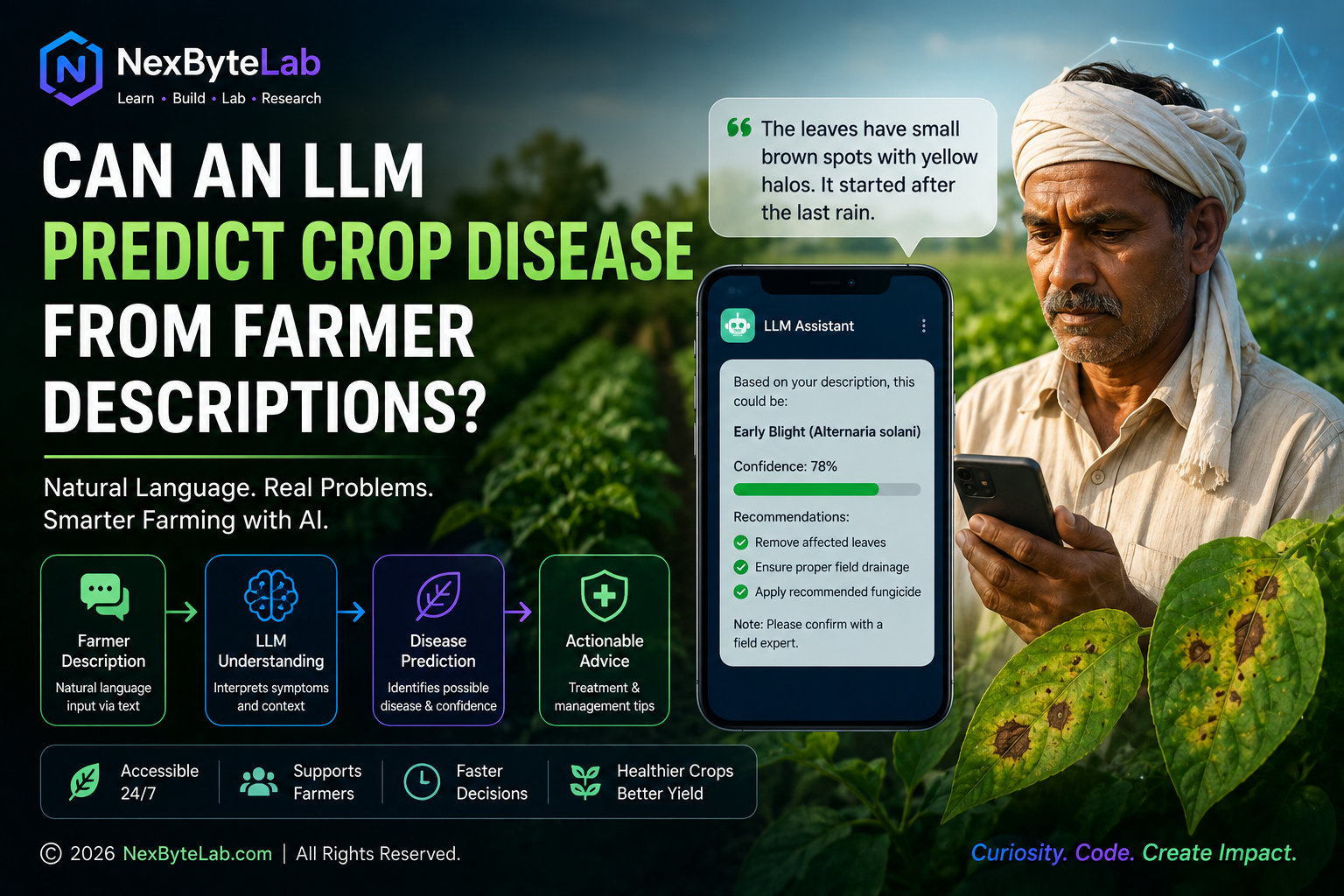
Can an LLM Predict Crop Disease from Farmer Descriptions?
Can an LLM predict crop disease from a plant description alone, without a photo?
The question nobody quite asks
A farmer in Maharashtra notices yellow rings spreading across her tomato leaves. She’s not a plant pathologist. She doesn’t have a lab down the road, and her signal isn’t always good enough to send a clear photo. What she has is a phone and a handful of words to describe what she’s seeing. So she types, or speaks: the leaves are curling, turning yellow from the edges, and there are small brown spots.
Can an AI actually tell her what’s wrong from that sentence alone?
It sounds like a small question, but the scale behind it is enormous. The UN’s Food and Agriculture Organization puts global crop losses from pests and disease at 20 to 40 percent of yield every single year (FAO, n.d.). In India, pre- and post-harvest losses from disease, pests, and poor handling run into billions of dollars annually. And a lot of the people growing that food have no expert to call. In Kenya, the ratio of trained agricultural extension officers to farmers can run as low as one for every 1,000 to 5,000 growers (Singh et al., 2024).
Large language models — the technology under ChatGPT, Gemini, and their competitors — are increasingly being pitched as a fix for that gap. But there’s a distinction buried in the question that’s easy to miss. Most of the well-known “AI plant doctor” tools, including the popular PlantVillage Nuru app used across East Africa, work by analyzing a photo of the leaf with computer vision (CGIAR, n.d.; Mohanty, Hughes, & Salathé, 2016). That’s a genuinely different task, and an easier one, than what this article is about: can the model work it out from words alone, with no image in sight?
Text-only diagnosis matters for reasons that have nothing to do with novelty. It’s what you’re left with when the network is too slow for a photo, when the problem is in the roots where a camera can’t reach, or when someone is talking to a chatbot over a basic voice call rather than typing on a smartphone. Language is also just a messier input than a photograph — vague, full of gaps, dependent on the farmer noticing and mentioning the right detail in the first place.
What “learning” even means here
It’s worth slowing down on this before getting to results, because “the AI learned to diagnose plant disease” hides at least four different things, and they don’t perform anywhere near the same.
The first is pretraining — the enormous, general reading phase every LLM goes through before anyone talks to it. A model like GPT-4 absorbs a huge slice of the internet: extension bulletins, plant pathology textbooks, farming forums, research papers. From that, it picks up statistical associations — yellowing leaves with a V-shaped pattern tend to appear near certain nutrient deficiencies in text, a white powdery coating tends to appear near “powdery mildew.” None of this is learned the way a pathologist learns from actually diagnosing plants. It’s learned as patterns in language, which is a much more fragile kind of knowledge than it sounds (Ji et al., 2023).
The second is fine-tuning: taking a pretrained model and training it further on a smaller, curated set of examples so it behaves better at one specific job. One study did exactly this, fine-tuning a Llama 2 model on agricultural Q&A data to build a crop-disease chatbot (Thottempudi, Balaji, & Mnkandla, 2025).
The third, and arguably the one doing the most real-world work right now, is retrieval-augmented generation, or RAG. Instead of trusting whatever the model happens to remember from pretraining, a RAG system searches a curated, trusted knowledge base in real time — extension documents, verified agronomy guides — and hands the model the relevant passages before it answers (Lewis et al., 2020). This is the backbone of Digital Green’s Farmer.Chat (Singh et al., 2024).
The fourth is newer and doesn’t touch training at all: it changes how the model reasons at the moment it answers. Chain-of-thought prompting pushes the model to work through symptoms step by step, weighing them against known disease profiles rather than pattern-matching straight to an answer. This is the technique behind ChatLD, or ChatLeafDisease, and it turns out to matter more than almost anything else in this story (Pan et al., 2025).
Put plainly: the model isn’t learning your plant. It already carries a large, general, somewhat unreliable base of agricultural knowledge from pretraining, and each of these techniques is a different way of making that knowledge more trustworthy at the moment someone actually needs an answer.
What the research actually shows
Here’s where it gets interesting, because the numbers split hard depending on which of those four techniques is doing the work.
Start with the unflattering result. The ChatLD researchers directly benchmarked general-purpose LLMs on crop disease classification using text descriptions of tomato disease symptoms. Raw GPT-4o got 45.9% right. Gemini-1.5-Pro got 56.1% (Pan et al., 2025). Neither is close to something you’d want to act on. Asking a leading LLM to name the disease from a bare description turns out to be barely better than guessing.
Then the researchers wrapped that same GPT-4o model in their chain-of-thought pipeline, forcing it to score how well the described symptoms matched a checklist of known disease features before committing to an answer. Accuracy on tomato disease jumped to 88.9%. On crops the system hadn’t been tuned for — grape, strawberry, pepper — it still averaged 94.4%. Tested against messier real-world field data rather than clean benchmark text, it dropped to a still-solid 77.3% (Pan et al., 2025). When the researchers stripped the scoring rules back out as a test, accuracy collapsed from 90.3% to 51.8% — a fairly clean demonstration that the reasoning structure, not some hidden extra training, is what’s actually producing the gain.
Multimodal and fine-tuned systems tell a similar story, though most papers in this space report accuracy on the combined image-plus-text task rather than text alone, which makes cross-comparison harder than it should be. A 2025 Scientific Reports paper built a system called LLMI-CDP by fine-tuning a vision-language model on 2,498 annotated crop images paired with disease Q&A, and it beat five other vision-language baselines on both identification and question answering (Wang et al., 2025). A 2024 case study on using GPT-4-vision as a “Plant Doctor” combined image recognition with a knowledge base covering more than 1,400 host plant types and 2,400 pathogens — but the authors were upfront that the field has a real measurement problem: “unlike traditional machine learning/deep learning models, the pre-trained GPT model lacks standardized methods for measuring accuracy” (Hue et al., 2024). There’s no shared benchmark yet, which makes every one of these numbers harder to compare against the next.
Then there’s the deployment-scale evidence, which asks a slightly different question. Farmer.Chat, running across Kenya, India, Ethiopia, and Nigeria, is the largest real-world test of an LLM fielding farmer questions, and pest and disease queries were its single most common topic (Singh et al., 2024). Across more than 300,000 real queries from over 15,000 users, the system answered around 75% of them, and users reported high satisfaction. But “satisfied” and “correct” aren’t the same measurement. The study tracked whether farmers got a relevant, well-communicated response, not whether an independent panel of pathologists confirmed each diagnosis. The authors are candid that 66% of the unanswered queries came down to gaps in the knowledge base rather than model failure, and the paper doesn’t report a hallucination rate for the answers it did give (Singh et al., 2024). That gap — a confident, well-written answer versus a correct one — is probably the central unsolved problem in this whole field.
One more data point worth having: AgroLLM, a RAG-based agricultural chatbot trained on university textbooks and research content, hit 93% accuracy on general agricultural knowledge questions when paired with GPT-4o Mini, ahead of Gemini 1.5 Flash and a smaller open model, Mistral-7B (Samuel, Skarga-Bandurova, Sikolia, & Awais, 2025). Disease diagnosis wasn’t the specific focus there, but it’s a clean illustration of how much a good retrieval layer raises the ceiling over a model working purely from memory.
Why words are harder than pictures
It’s worth pausing on why those raw text-only numbers — 46% and 56% — sit so far below what image-based tools manage. The original, now widely-cited deep learning study on image-based disease detection trained on the PlantVillage dataset, over 54,000 leaf images spanning 14 crops and 26 diseases, and reported accuracy as high as 99.35% on its held-out test set (Mohanty, Hughes, & Salathé, 2016). Field tools built on similar computer-vision principles, like PlantVillage Nuru’s cassava detector, have reported 80–90% accuracy under real farm conditions in Africa (CGIAR, n.d.).
A photograph strips out most of the ambiguity. Lesion shape, color gradient, spatial pattern — a camera captures all of it precisely and consistently, every time. A sentence doesn’t. “Leaves are turning yellow” could mean a nutrient deficiency, early blight, a viral infection, waterlogging, or nothing more than old leaves naturally dying back, and most farmers won’t spontaneously volunteer the detail that would tell those apart. That’s exactly the gap chain-of-thought prompting and structured follow-up questions try to close — pushing the model to behave less like a guesser and more like someone running a proper symptom interview.
There’s a language problem layered on top of this, too. Farmers in smallholder regions often describe symptoms in a local dialect, using folk terms for a disease that don’t map cleanly onto the scientific vocabulary any model was trained on. Farmer.Chat handles this by translating queries before they ever reach the core model (Singh et al., 2024), which solves one problem while quietly introducing another: translation is itself a place where diagnostic detail can get lost.
Where it still falls short
None of this is a case for treating these tools as finished products. A few limitations show up again and again across the literature.
Hallucination hasn’t gone away. Every system reviewed here acknowledges, in some form, that the underlying model can produce fluent, confident, and simply wrong output (Ji et al., 2023; Thottempudi, Balaji, & Mnkandla, 2025). A wrong answer from a lookup table looks wrong. A hallucinated diagnosis doesn’t — it reads exactly as trustworthy as a correct one, which arguably makes it more dangerous than a tool that just fails visibly.
There’s no agreed benchmark. Plant pathology and computer vision have shared, decades-old test sets like PlantVillage that let researchers compare results directly. Text-based LLM diagnosis is too new for that. Studies use different crops, different disease sets, and different definitions of “correct,” a gap the GPT-4-vision Plant Doctor authors called out themselves (Hue et al., 2024).
Models still confuse disease with ordinary stress. Nutrient deficiency, drought, cold damage — these can look and sound a lot like an actual pathogen, and multiple papers note the systems struggle with this distinction much like a human beginner would (Hue et al., 2024).
Most real-world failures trace back to missing knowledge, not bad reasoning. In the Farmer.Chat data, two out of three unanswered questions failed because the answer simply wasn’t anywhere in the retrieval sources, not because the model reasoned poorly (Singh et al., 2024). An LLM is only as good as the material it’s allowed to search.
And even the strongest system here admits its reasoning is still shallow next to an expert. The LLMI-CDP authors flagged “considerable room for improvement, especially in deep reasoning capabilities” as an open issue in their own results (Wang et al., 2025).
Where this is heading
The pattern across this research is fairly consistent. A raw, general-purpose LLM asked to diagnose a crop from a bare description isn’t reliable yet. But every technique that adds structure to the process — chain-of-thought reasoning, retrieval from a verified knowledge base, targeted fine-tuning — closes that gap, sometimes by a huge margin, as in ChatLD’s jump from under 50% to roughly 90% (Pan et al., 2025). The systems showing the most promise right now combine several of these techniques at once, and lean on text mainly to gather context a photo can’t provide on its own: when the symptoms started, what the recent weather has been like, what the farmer already tried.
For a research scholar, the open problems aren’t hard to name. Someone needs to build a shared, public benchmark of real farmer-phrased symptom descriptions, not clean textbook language, paired with confirmed lab diagnoses. Hallucination rates need to be measured directly instead of inferred from user satisfaction. And performance needs testing across the dozens of local languages and dialects farmers actually speak, rather than English-only test sets, which is where most of the current literature still lives.
For the farmer at the center of the question, the honest takeaway is more modest. A well-built LLM assistant, especially one backed by a verified knowledge base, is a genuinely useful first opinion and a decent triage tool. It is not, on the evidence collected here, a replacement for a plant pathologist when getting the answer wrong actually costs something.
The short version
Can an LLM predict crop disease from a farmer’s description alone? Mostly not on its own, but increasingly well once it’s made to reason step by step and given something reliable to check its work against. The field is moving from confident guesswork toward something closer to structured, checkable reasoning, and that shift matters more than any single accuracy number in this piece.
References
CGIAR Platform for Big Data in Agriculture. (n.d.). PlantVillage Nuru: Pest and disease monitoring using AI. Retrieved from https://bigdata.cgiar.org/digital-intervention/plantvillage-nuru-pest-and-disease-monitoring-using-ai/
Food and Agriculture Organization of the United Nations. (n.d.). Understanding the context — Pest and Pesticide Management. Retrieved from https://www.fao.org/pest-and-pesticide-management/about/understanding-the-context/en/
Hue, Y., Kim, J. H., Lee, G., Choi, B., Sim, H., Jeon, J., Ahn, M.-I., Han, Y. K., & Kim, K.-T. (2024). Artificial Intelligence Plant Doctor: Plant disease diagnosis using GPT4-vision. Research in Plant Disease, 30(1), 99–102.
Ji, Z., Lee, N., Frieske, R., Yu, T., Su, D., Xu, Y., Ishii, E., Bang, Y. J., Madotto, A., & Fung, P. (2023). Survey of hallucination in natural language generation. ACM Computing Surveys, 55(12), Article 248. https://doi.org/10.1145/3571730
Lewis, P., Perez, E., Piktus, A., Petroni, F., Karpukhin, V., Goyal, N., Küttler, H., Lewis, M., Yih, W., Rocktäschel, T., Riedel, S., & Kiela, D. (2020). Retrieval-augmented generation for knowledge-intensive NLP tasks. In Advances in Neural Information Processing Systems 33 (NeurIPS 2020). https://arxiv.org/abs/2005.11401
Mohanty, S. P., Hughes, D. P., & Salathé, M. (2016). Using deep learning for image-based plant disease detection. Frontiers in Plant Science, 7, 1419. https://doi.org/10.3389/fpls.2016.01419
Pan, J., Zhong, R., Xia, F., Huang, J., Zhu, L., Yang, Y., & Lin, T. (2025). ChatLeafDisease: A chain-of-thought prompting approach for crop disease classification using large language models. Plant Phenomics, 7, Article 100094. https://doi.org/10.1016/j.plaphe.2025.100094
Samuel, D. J., Skarga-Bandurova, I., Sikolia, D., & Awais, M. (2025). AgroLLM: Connecting farmers and agricultural practices through large language models for enhanced knowledge transfer and practical application. arXiv preprint. https://arxiv.org/pdf/2503.04788
Singh, N., Wang’ombe, J., Okanga, N., Zelenska, T., Repishti, J., K, J. G., Mishra, S., Manokaran, R., Singh, V., Rafiq, M. I., Gandhi, R., & Nambi, A. (2024). Farmer.Chat: Scaling AI-powered agricultural services for smallholder farmers. arXiv preprint arXiv:2409.08916. https://arxiv.org/abs/2409.08916
Thottempudi, S. G., Balaji, V., & Mnkandla, E. (2025). Crop disease management with LLMs. In Proceedings of the 1st Workshop on LLM Reasoning on Medicine: Challenges, Opportunities, and Future (pp. 1–8). Association for Computational Linguistics. https://aclanthology.org/2025.llm4medr-1.1.pdf
Wang, Y., Wang, F., Chen, W., et al. (2025). A large language model for multimodal identification of crop diseases and pests. Scientific Reports, 15, 21959. https://doi.org/10.1038/s41598-025-01908-0ge model for multimodal identification of crop diseases and pests. Scientific Reports, 15, 21959. https://doi.org/10.1038/s41598-025-01908-0
Related Reading
- AI in Healthcare: What’s Actually Working — another domain where LLMs meet real-world constraints
- Benchmarking Open-Source LLMs: A Practical Comparison — how to evaluate which model fits a use case like this