
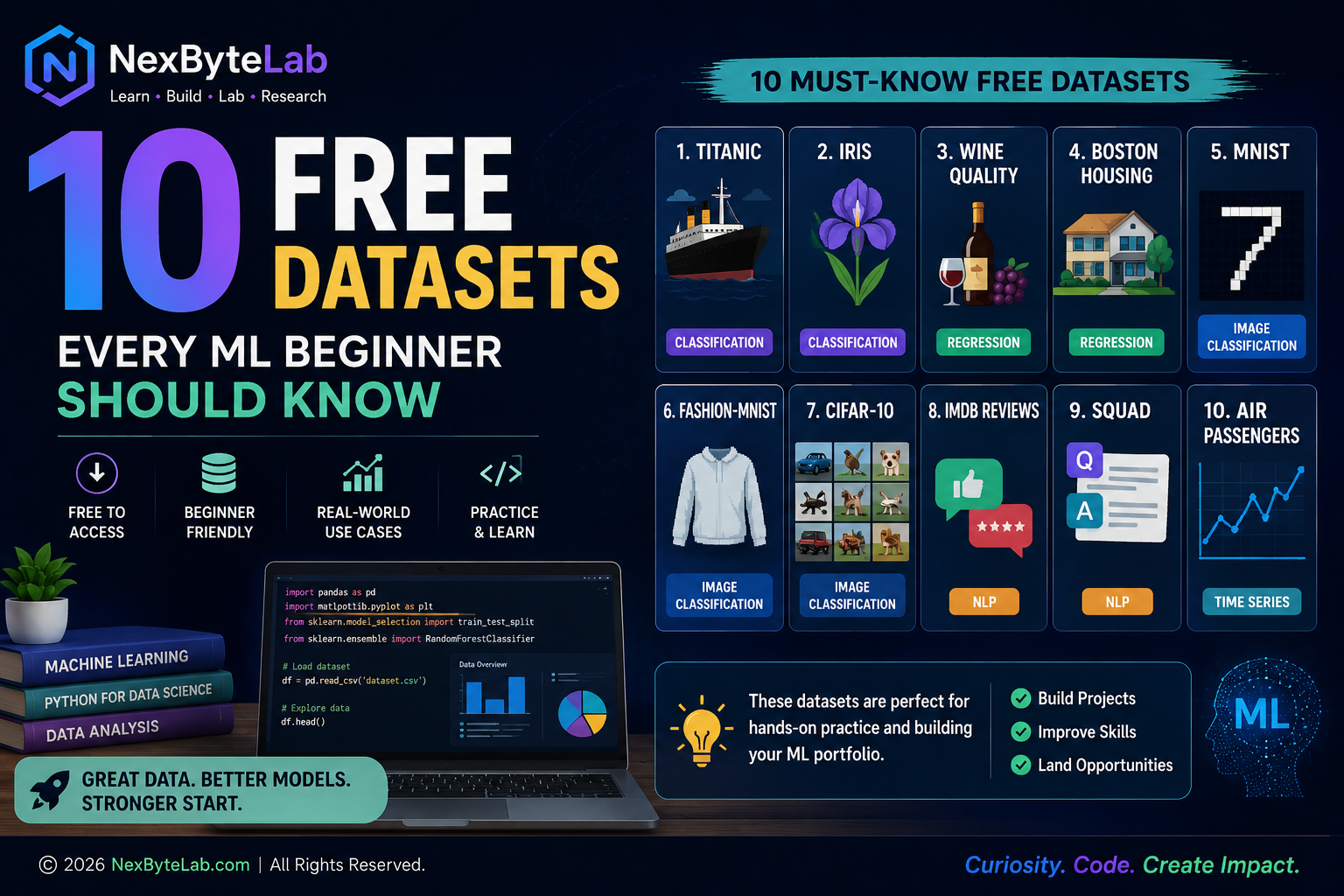
10 Free Datasets Every ML Beginner Should Know
This roundup of free datasets for ML beginners focuses on options you can actually run on a laptop today.
If you are learning machine learning, one of the quickest ways to understand it is to work with real data.
You do not need a huge dataset or an expensive cloud setup to get started. In fact, there are excellent free datasets available that are small enough to run on an ordinary laptop.
The important thing is to choose the right dataset for what you want to learn.
Below are ten datasets that can take you from your first prediction model to image recognition, natural language processing and time-series forecasting.
1. Titanic — Predicting Who Survived
Best for: Classification
Difficulty: Beginner
Source: Kaggle
The Titanic dataset is probably one of the best-known starting points in machine learning.
The question is simple:
Can we use information about a passenger to predict whether that person survived the Titanic disaster?
The data contains information such as passenger age, sex, ticket class, fare, family members travelling with them and port of embarkation. The training data also tells us whether each passenger survived. [1]
That makes it a useful dataset for understanding one of the most common machine learning problems: classification.
A beginner can use it to learn how to:
- explore a dataset,
- deal with missing information,
- convert categories into numbers,
- select useful features,
- train a classification model, and
- measure how well the model performs.
It is also useful because the problem itself is easy to understand. You can concentrate on learning machine learning rather than first trying to understand a complicated business problem.
Try this question:
Can passenger information be used to predict survival?
2. Wine Quality — Can a Computer Estimate Wine Quality?
Best for: Classification and regression
Difficulty: Beginner to intermediate
Source: UCI Machine Learning Repository
The Wine Quality dataset contains information about red and white Portuguese Vinho Verde wines.
Instead of photographs or written descriptions, each wine is represented by measurements such as acidity, residual sugar, chlorides, pH, sulphates and alcohol content. The dataset also contains a quality score for the wine. [2]
This creates an interesting machine learning question:
Can the chemical properties of a wine help predict its quality?
The dataset is especially useful because it can be approached as either a classification or a regression problem.
It also introduces beginners to something they will frequently encounter with real data: the different outcome categories are not equally represented. The UCI documentation specifically notes that the quality classes are not balanced. [2]
Try this question:
Which chemical properties appear to have the strongest relationship with wine quality?
3. Adult Income — Predicting an Income Category
Best for: Classification and data preprocessing
Difficulty: Beginner to intermediate
Source: UCI Machine Learning Repository
The Adult dataset, sometimes called the Census Income dataset, is based on census information.
It contains 48,842 records and 14 input features, including variables such as age, education, occupation and working hours. The machine learning task is to predict whether a person’s annual income falls above or below $50,000. [3]
What makes this dataset particularly useful for learners is that not everything is conveniently represented as numbers. Some fields are categories, and some contain missing values. [3]
That means you have to prepare the data before simply feeding it into a model.
This process — often called data preprocessing — is a major part of practical machine learning.
The dataset can also be used to introduce an important discussion: a model may learn patterns from historical demographic data, but that does not automatically mean those patterns should be used to make real-world decisions about people.
Try this question:
How much does the model change when different features are removed?
Learning Computer Vision
Once you are comfortable working with rows and columns of data, image datasets provide a good introduction to another branch of machine learning: computer vision.
4. MNIST — Teaching a Computer to Read Handwritten Numbers
Best for: First image-classification project
Difficulty: Beginner
MNIST contains images of handwritten digits from 0 to 9.
It includes 60,000 training examples and 10,000 test examples and has been widely used as a benchmark for pattern-recognition and machine-learning methods. [4]
Imagine showing a computer thousands of handwritten numbers and asking:
“Which digit is this?”
That is essentially the MNIST problem.
Because the images are small and the problem is relatively straightforward, MNIST is a convenient place to understand how an image can be represented as numbers and how a model learns visual patterns.
It can also provide a first introduction to neural networks.
Try this question:
Can a simple neural network recognise handwritten digits accurately?
5. Fashion-MNIST — Recognising Clothes Instead of Numbers
Best for: Image classification
Difficulty: Beginner to intermediate
Source: Zalando Research
Once MNIST starts feeling too easy, Fashion-MNIST provides a natural next challenge.
Instead of handwritten numbers, the images show fashion products such as shirts, trousers, dresses, coats, sandals, sneakers, bags and ankle boots.
Fashion-MNIST contains 70,000 grayscale images across 10 categories, divided into 60,000 training examples and 10,000 test examples. Each image is 28 × 28 pixels. [5]
The creators designed it as a direct replacement for MNIST for benchmarking machine-learning algorithms. [5]
This means you can often use almost the same learning process while working on a more visually challenging problem.
Try this question:
Which types of clothing does the model confuse most often?
6. CIFAR-10 — Moving to Real Colour Images
Best for: Convolutional neural networks
Difficulty: Intermediate
Source: University of Toronto
CIFAR-10 takes image classification another step forward.
It contains 60,000 colour images divided into 10 categories, with 50,000 images used for training and 10,000 for testing. [6]
The categories include objects such as airplanes, automobiles, birds, cats, deer, dogs, frogs, horses, ships and trucks.
Unlike MNIST and Fashion-MNIST, these are colour images containing much more visual variation.
A cat, for example, will not always appear in exactly the same position, size or background.
That makes CIFAR-10 a useful dataset for experimenting with convolutional neural networks (CNNs) and seeing why recognising objects in photographs is harder than recognising handwritten digits.
Try this question:
Why does the model find some classes easier to recognise than others?
Learning Natural Language Processing
Machine learning is not limited to numbers and images. Computers can also learn patterns from human language.
That brings us to Natural Language Processing, or NLP.
7. IMDb Movie Reviews — Can AI Understand Positive and Negative Opinions?
Best for: Sentiment analysis
Difficulty: Beginner to intermediate
Source: Stanford
The Large Movie Review Dataset contains 50,000 labelled movie reviews for training and testing sentiment-classification models. The dataset is evenly divided into 25,000 training reviews and 25,000 test reviews. [7]
The task is straightforward:
Read a movie review and decide whether the reviewer expressed a positive or negative opinion.
For example:
“The movie was fantastic.”
is clearly different from:
“The movie was disappointing.”
Humans recognise this almost immediately. A machine has to learn the relationship between words, phrases and the sentiment expressed by the writer.
That makes the dataset an excellent introduction to text preprocessing, word representations and sentiment classification.
Try this question:
Can a machine predict whether a movie review is positive or negative from the text alone?
8. SQuAD — Teaching Machines to Answer Questions
Best for: Question answering
Difficulty: Intermediate to advanced
Source: Stanford
The Stanford Question Answering Dataset, better known as SQuAD, moves beyond simply classifying text.
The general idea is to give a machine a passage of text followed by a question about that passage. The model must identify the appropriate answer from the information available in the text.
For example, imagine providing a paragraph about the Moon and then asking:
“How long does the Moon take to orbit Earth?”
The system must understand the question, examine the passage and locate the relevant answer.
This makes SQuAD useful for understanding machine reading comprehension and question-answering systems.
It is a bigger step than sentiment analysis, so beginners may want to explore simpler text-classification problems before attempting it.
Try this question:
Can a model locate the correct answer to a question inside a paragraph?
Learning Regression and Forecasting
Not every machine learning problem involves choosing a category. Sometimes the objective is to predict a number.
9. California Housing — Predicting House Values
Best for: Regression
Difficulty: Beginner
Source: scikit-learn / StatLib
The California Housing dataset is a useful introduction to regression.
Instead of predicting a category such as “survived” or “did not survive,” the goal is to predict a numerical value.
The dataset available through scikit-learn contains 20,640 samples with eight input features. The target represents average house values. [8]
This allows beginners to explore questions such as:
Can information about an area help predict its housing values?
It is useful for learning linear regression, decision trees, random forests and other regression techniques.
More importantly, it introduces a major concept in machine learning:
Classification predicts a category. Regression predicts a number.
Try this question:
Which variables are most useful for predicting housing values?
10. M4 Dataset — Learning to Predict What Happens Next
Best for: Time-series forecasting
Difficulty: Intermediate to advanced
Source: M4 Forecasting Competition
Most of the datasets above contain independent examples. Time-series data is different because time and sequence matter.
The M4 dataset was created for the M4 forecasting competition and contains training and test series covering several frequencies, including yearly, quarterly, monthly, weekly, daily and hourly observations. [9]
The task is essentially:
Given what happened in the past, can we predict what happens next?
That is the foundation of time-series forecasting.
The same type of thinking is used when forecasting sales, demand, traffic, energy consumption, inventory requirements and many other real-world quantities.
M4 is substantially larger and more challenging than datasets such as Titanic or MNIST, so it is better treated as a later project rather than your first machine learning exercise.
Try this question:
Can past observations be used to forecast future values?
Which Dataset Should You Start With?
There is no need to tackle all ten at once.
A sensible learning path is:
Titanic → Wine Quality → Adult → California Housing → MNIST → Fashion-MNIST → CIFAR-10 → IMDb → SQuAD → M4
This progression gradually introduces different types of machine learning problems:
Classification → Regression → Computer Vision → NLP → Forecasting
More importantly, try not to treat datasets as exercises where the only objective is to achieve the highest possible accuracy.
For every dataset, ask yourself:
What problem am I solving?
What does each column or feature mean?
What information is missing?
What assumptions am I making?
How will I know whether my model is actually useful?
Those questions are often more important than the algorithm itself.
Where Can You Find More Free Datasets?
Three resources are particularly useful when looking for additional machine-learning datasets:
Kaggle provides datasets, notebooks and competitions covering a wide range of machine-learning problems.
UCI Machine Learning Repository has been used by researchers and students for decades and contains hundreds of datasets suitable for classification, regression and other machine-learning tasks. [10]
Hugging Face Datasets is particularly useful for modern machine learning and natural-language-processing projects.
Once you become comfortable with the datasets above, these repositories can provide enough material for hundreds of experiments.
References
[1] Kaggle. Titanic – Machine Learning from Disaster. Kaggle.
Dataset and competition page: Kaggle Titanic dataset
[2] Cortez, P., Cerdeira, A., Almeida, F., Matos, T., & Reis, J. (2009). Wine Quality. UCI Machine Learning Repository. DOI: 10.24432/C56S3T.
UCI Wine Quality dataset
[3] Becker, B., & Kohavi, R. (1996). Adult. UCI Machine Learning Repository. DOI: 10.24432/C5XW20.
UCI Adult dataset
[4] LeCun, Y., Cortes, C., & Burges, C. J. C. The MNIST Database of Handwritten Digits. MNIST contains 60,000 training and 10,000 test samples.
MNIST database
[5] Xiao, H., Rasul, K., & Vollgraf, R. (2017). Fashion-MNIST: a Novel Image Dataset for Benchmarking Machine Learning Algorithms. arXiv:1708.07747.
Fashion-MNIST repository
[6] Krizhevsky, A. (2009). Learning Multiple Layers of Features from Tiny Images. University of Toronto. The official CIFAR page documents the 60,000-image CIFAR-10 dataset and its training/test split.
CIFAR-10 dataset
[7] Maas, A. L., Daly, R. E., Pham, P. T., Huang, D., Ng, A. Y., & Potts, C. (2011). Learning Word Vectors for Sentiment Analysis. Proceedings of ACL-HLT 2011, pp. 142–150.
Stanford Large Movie Review Dataset
[8] Pace, R. K., & Barry, R. (1997). Sparse Spatial Autoregressions. Statistics & Probability Letters, 33(3), 291–297. California Housing is distributed through scikit-learn as a regression dataset containing 20,640 samples and eight input features.
scikit-learn California Housing documentation
[9] Makridakis, S., Spiliotis, E., & Assimakopoulos, V. (2020). The M4 Competition: 100,000 time series and 61 forecasting methods. International Journal of Forecasting, 36(1), 54–74. The official M4 repository provides the competition’s training/test datasets, benchmarks and submitted methods.
Official M4 Competition repository
[10] UCI Machine Learning Repository. University of California, Irvine. The repository maintains hundreds of datasets used for machine-learning research and education.
UCI Machine Learning Repository
Note: Dataset descriptions in this article have been written in original language for educational purposes. Dataset names, factual characteristics and numerical details are attributed to their respective original sources.
Related Reading
- Python for Data Science: The Essential Toolkit — the Python toolkit to work with these datasets
- Getting Started with Statistics for Machine Learning — the statistics to evaluate models trained on them