
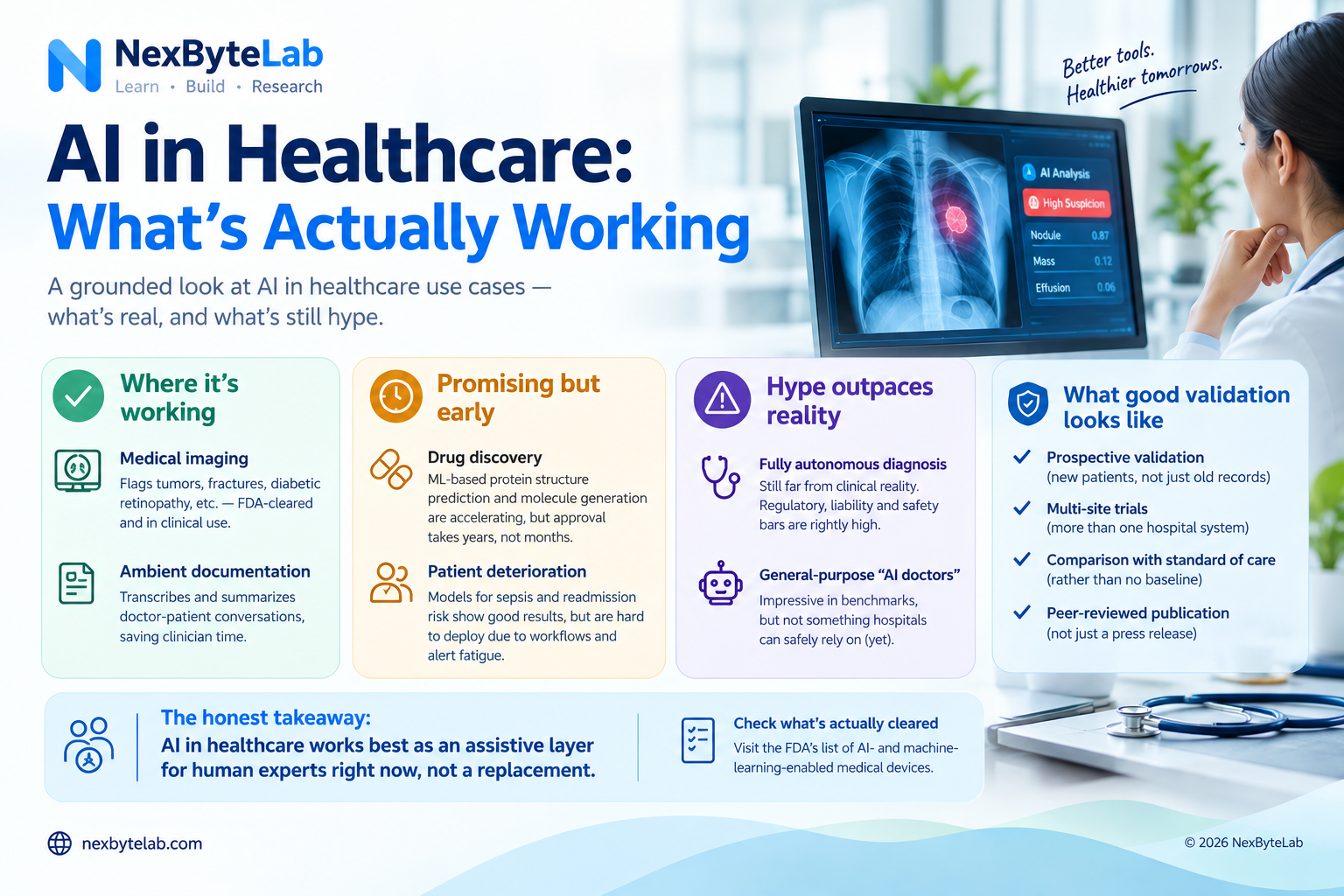
AI in Healthcare: What’s Actually Working
This is a grounded look at AI in healthcare use cases — what’s real, and what’s still hype.
AI in healthcare gets a lot of hype, and a lot of skepticism. This post tries to stay grounded: what’s actually deployed and delivering value today, versus what’s still mostly research?
Where it’s working
Medical imaging is the clearest success story — models that flag likely tumors, fractures, or diabetic retinopathy in scans are FDA-cleared and in clinical use, typically as a second reader that helps radiologists prioritize and catch things they might miss. Similarly, ambient documentation tools that transcribe and summarize doctor-patient conversations are freeing up clinician time at meaningful scale.
Where it’s promising but early
Drug discovery is seeing real acceleration from ML-based protein structure prediction and molecule generation, but the timeline from ‘promising candidate’ to ‘approved drug’ is still measured in years, not months. Predictive models for patient deterioration (sepsis risk, readmission risk) show good results in papers but are notoriously hard to deploy well because hospital workflows and alert fatigue matter as much as model accuracy.
Where the hype outpaces reality
Fully autonomous diagnosis and general-purpose ‘AI doctors’ remain far from clinical reality. Regulatory, liability, and safety bars are appropriately high, and the gap between an impressive benchmark result and something a hospital can safely rely on is bigger than headlines suggest.
The honest takeaway: AI in healthcare works best as an assistive layer for human experts right now, not a replacement for them.
Where to check what’s actually cleared
If you want to see what’s really authorized rather than what a press release claims, the FDA maintains a public list of AI- and machine-learning-enabled medical devices it has cleared or approved. It’s a useful reality check: most entries are narrow, single-task tools — an imaging aid, a triage flag — rather than anything resembling an autonomous diagnostician, which lines up with the grounded picture of AI in healthcare above.
What good clinical validation actually looks like
Not all evidence behind an AI in healthcare claim carries the same weight. The stronger end of the spectrum looks like this: prospective validation (tested on new patients going forward, not just old records), multi-site trials that span more than one hospital system, a comparison against the current standard of care rather than against no baseline at all, and results published in a peer-reviewed journal rather than a press release or conference poster. Retrospective, single-site studies can still be a useful early signal, but they are far more prone to inflated performance than a claim usually admits.
A practical rule of thumb: the more autonomous the claimed role — a tool that flags versus a tool that diagnoses versus a tool that decides — the higher the bar for evidence should be before you trust it, and the more that gap between benchmark performance and real clinical deployment tends to widen.
Three quick questions cut through most of the hype when a new AI in healthcare claim shows up in your feed: was it tested prospectively on new patients, was the comparison against the actual standard of care, and has it been deployed at more than one site? If the answer to any of these is unclear, treat the result as promising rather than proven — that distinction is usually where the honest story and the press-release version of the story diverge. It is a small habit, but it is the single biggest filter for separating AI in healthcare tools that are genuinely ready for clinical use from ones that are still, honestly, research.
Related Reading
- Can an LLM Predict Crop Disease from Farmer Descriptions? — the same grounded-AI question, applied to agriculture
- Benchmarking Open-Source LLMs: A Practical Comparison — how to evaluate which model fits a use case like this